sunnuntai 7. heinäkuuta 2013

M.S.S.S Episode 1

My god. I've got lots to tell about this. Now I'm starting a new branch of this series, where I'll keep up with you, every single week with a new episode of Monogatari Series Second Season, which I'll shorten to M.S.S.S

Surprisingly Complex: M.S.S.S Episode 1

When I heard that one of the novels is from Hanekawa's point of view, I went nuts. I was so damn waiting for this, and the second Hanekawa started narrating, I was so damn pleased. There would have been no better place to put this. I knew it was coming, and I loved it.

Basically, the first episode is just setting us up with the Tiger, and we don't really know what it is yet. We also see hysteric Senjougahara, of which I will talk in a bit and some lesbian tendencies, which are actually not lesbian tendencies. We also confirm, that yes, Hanekawa sees Hachikuji from time to time, which makes lots of sense.

So. Starting off with the character lens, which I goddamn love to talk about. There isn't a major change in art style, which means that the animating studio thinks that this is how everyone sees the world, with less color than normally, but with more accented ones. Like the reds stand out as RED, greens stand out as GREEN. This is an interesting perspective into the human mind, be it intentional or not. We humans categorize things easily, thus every green thing we see is green, not exactly the color that it is, like seafoam-green or forest green. I couldn't have talked about this before, because we've only seen the perspection of Araragi.

El Tigre here is very colorful
Hanekawa's character lens is actually quite different than Araragi's, and it's noticeable if you pay attention. The color palette during the Tiger scene is one where we can see the difference. There where in Araragi's view this kind of scenes accompany lots of pure white and pastel colors, Hanekawa's have more creamy feel. Like the greens in the sky are very lime, and the Tiger itself is more color-FULL. Not that there are more colors, but the colors are much more vivid. This is a minor thing, but someone who pays attention can notice this.

There's also the fully new "scene", White scene, which I think are somehow connected to the cat. Like how red scenes are usually connected to some strong feelings, and black scenes to the narrator simply closing their eyes. There's also a purple scene for a while, that is probably connected to Senjougahara (Big surprise there).

Also, in the middle of the episode, there is a chapter that's missing. It's that Hanekawa either turned into the cat or the tiger in the night, or there's something she just tries to forget. I guess it could be that Tiger is the white, where as the cat is the black, and in the end there's some kind of mental showdown? That'd be cool.

Her response to this was pretty stupid for a genius
Onto Hanekawa herself. As she narrates, she says that this story is meant to tell us how she is actually just a puny human being, not the inconceivable Codex of Ultimate Wisdom we've come to know her as. She also does act slightly different during this episode than she does usually, which could be of two reasons: She either acts the way we see her normally as because of Araragi, or Araragi's perception of what Hanekawa is has tricked us. Remember, now she cannot lie to us without lying to herself, which could be an interesting plotpoint somewhere during the series, where we are led to believe something is different than what it is because the narrator lies to themselves and thus to the viewer.

She also states in the end that she still loves Araragi, which is kind of pointless, because of ending of Nekomonogatari. Hanekawa Triangle is brought "back", but it only exists in Hanekawa's hopeful mind and Senjougahara's nightmares. Araragi is not the kind of guy to sway from his promises easily, especially for himself. He promised to find someone else to love, and he did. Or more like he forced himself to love her, depends on the viewpoint. But remember, forcing yourself can be good because with trying can it become something beyond. Depending on the viewpoint.

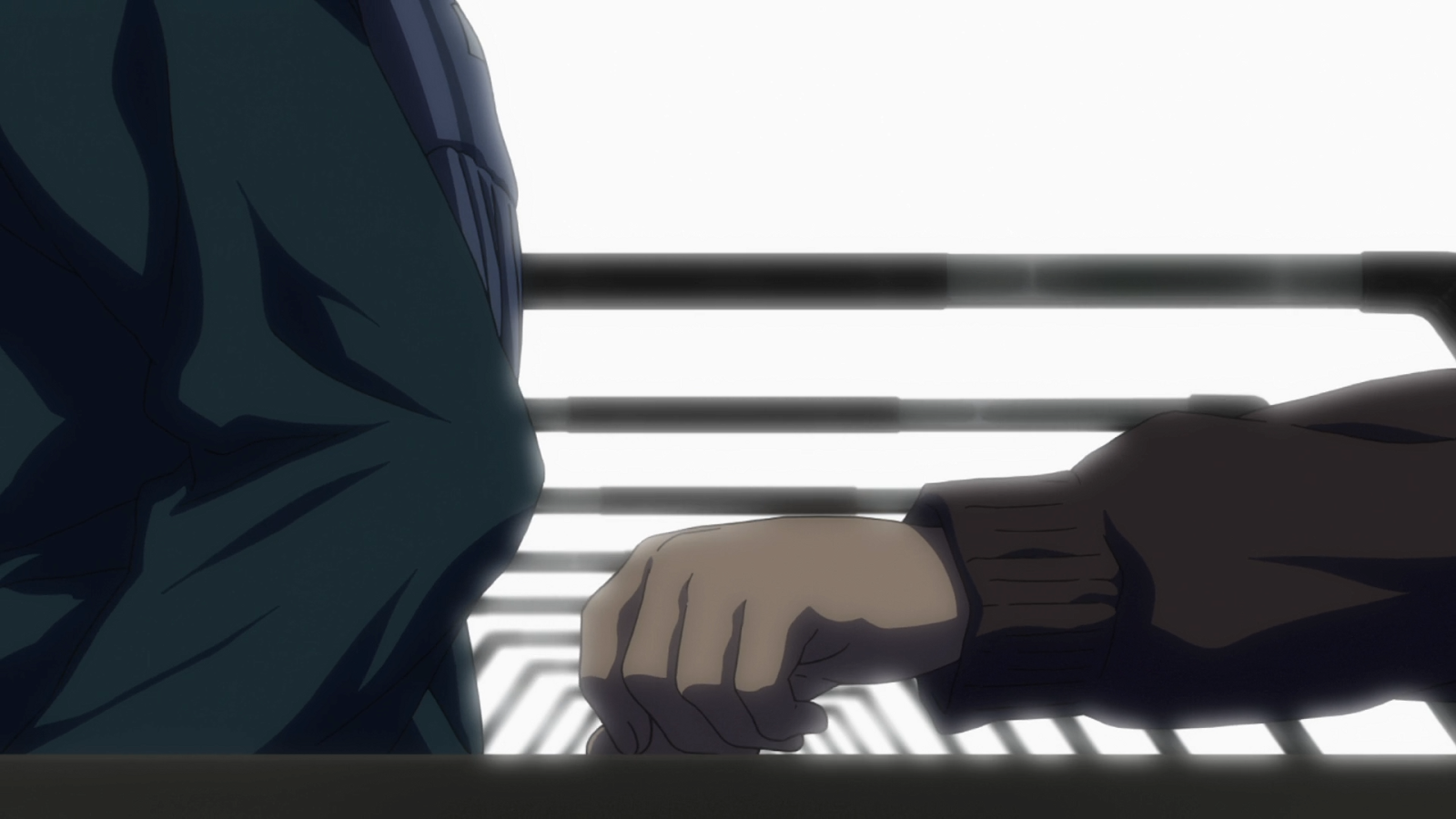
Even Senjougahara loses her shit sometimes!
So, to our other protagonist, Senjougahara. I haven't talked about the fact yet, that every single character in the series also somehow symbolize the oddity or apparition they have come to deal with. Senjougahara's has been the crab, and it's more abstract than of the others. Where as Hachikuji has her backpack as a shell and talking to her slows you pretty much, Senjougahara's crab lies inside. It's a god, so it is always there, yet isn't. The idea is, that she's a tough on the outside, but soft in the inside, as we see in this episode. She goes absolutely hysteric when she finds Hanekawa sleeping in the ruined Eikou Cram School. She loses the tough shell and becomes incredibly soft. It could also be seen, that Senjougahara understands that if something happens to Hanekawa, his and Araragi's relationship would definitely go to ruin. I believe she worries for all three of them, and that she's actually one of the more emotionally soft characters, she just hides it well.

Also, Senjougahara's lesbian intentions weren't actually sexual, she's just curious of Hanekawa's body, because Araragi is... You know... And also bragging rights.

NEXT WEEK, MORE!

TL;DR?

Change of perspective? Awesome!

lauantai 22. kesäkuuta 2013

Steins;Gate: Negative Character Development

Surprisingly Complex: Steins;Gate

Steins;Gate has lots of things that are literally said to the viewer, yet only describe vaguely their real meanings. It's a rare series in a way that it actually deals more with the psychological aspect of time travel than just the usual butterfly effect and such. Even though butterfly effect for example is still damn well executed in it. But it still won't win out the main prize, as that goes to Steins;Gate:s protagonist, Okabe Rintarou, and his negative character development and the way it's shown to us. It's just pure ingenious.

Okabe Rintarou is a goofball in the beginning of the series and could easily be just put into the obnoxious comic relief -category, but what people miss there, is that actually, almost all of Okabe's character development happened BEFORE the series itself. It's not really shown as it is handwaved, but it can be seen. Okabe's "real" character development was actually his self turning more and more like Hououin Kyouma, that started just as an act. An act to save Mayuri from herself. This goes into the interpretation zone, but that's what I do the best (I think). The flashback where Mayuri is reaching for the sky and the "Angel Ladder" appears, was the point where Okabe's downfall began. He said to her "You are my hostage. You can't go." marking the beginning of Hououin Kyouma taking over his mind. (I interpret that he might have actually done that somewhere else than a graveyard, a bridge perhaps?)

Goodbye Okarin, Hello Hououin
Of course, it's just interpretation, and even without it, the signs are obvious. During the series, the more time he spends with Makise, the more he goes back to being the sane Okabe Rintarou, not the mad Hououin Kyouma. It's actually shown several times in the few last episodes, where he tries to talk like Hououin Kyouma, but sounds like he doesn't even believe his own words, or doesn't talk to his phone until someone notices it (Until he gets better). It was not an integral part of him anymore. Big part of the absolute wonder that is Okabe is the voice actor, who nails every little emotion in the speech mannerisms, in the subtle change of tones, and of course, the fantabulamous laugh. 

In episode 22 it's shown how Okabe Rintarou has come victorious in the battle against Hououin Kyouma. His dramatic speech turns from comical to tragic when he starts to sound like he doesn't even care or believe his own bull anymore. Mayuri even says: "You don't have to talk like that anymore" and the only response he can muster is a surprised face and a sad monologue. "Just as Hououin Kyouma has died, the Phone Microwave should die, as well." The battle of Ragnarok, that was actually just two personalities fighting, was finally over, and he reached Beta Timeline, his own incomplete Valhalla.

The end (Episode 24) really shows how he got the grip back. His negative character development was complete. He was completely sane Okabe, who just acts the part of Hououin Kyouma. I loved the aspect where for an insane plan, you need the insane man, making Okabe act like Hououin to get a grip of the mad scientist that lurks in his brain. The one that had slowly taken over him during all the years he was with Mayuri. It can be seen that it isn't the "real" Hououin Kyouma we've seen in the past, but just Okabe being silly. It's even remarked by Mayuri: "Mayushii likes Okarin better when he's like this", meaning embracing Hououin, but not being taken over by him. 

That's all from Hououin, but there's more

All alone with your insanity
Another interesting character is Moeka. She shows the dependence some people have for others, and the utter insanity of being abandoned. The series made you feel sorry for the one who killed Mayuri, the one who deemed insanity upon insanity on Okabe. It's really effective to show the character as a total emotional wreck after they've been abandoned. She was so blind on it, that she actually didn't notice that Future Gadgets Lab could have been a good option for her. I don't know if she already had pledged absolute loyalty, but it wouldn't have been impossible, right?

Rukako is another good example. Why did he like Hououin more, even though Okabe was always there? Because he felt that as years had passed, Hououin had become what Okabe couldn't, and as such, what Okabe wanted to be. Which was actually false as Okabe didn't become Hououin for himself. Okabe even lampshades many times that becoming Hououin was a stupid idea to begin with. 

Mayuri's role is, unsurprisingly, damn essential for the story, as she represents the past, where as Kurisu represents the future. The scene where Hououin Kyouma is born (Picture in the very upper corner) is really heartwarming as you can just sense their connection. "So Mayushii is your hostage, right?" is a random line without the context, but in the context, the impact is huge. It just shows the trust and care the two share, purely. It is sadly also turned against him. Notice how every time Mayuri dies, the world turns monochrome? It's because he feels he has failed, not in saving her currently, but in his lifelong mission of saving her. The whole reason for Hououin's existence is doubted there, as it was his way of saving her, but it had failed him nonetheless. He blamed himself of becoming Hououin, and that was his sin.


Random trivia:      

*Notice how the Divergence Meter's display is very similar to Phone Microwave's power display? Clever.

TL;DR?


Okabe's biggest enemy is Hououin. The fight is just not shown.

tiistai 18. kesäkuuta 2013

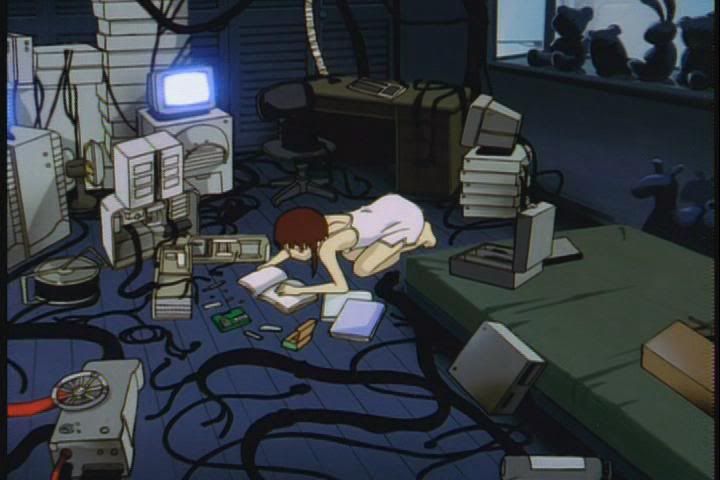
Serial Experiments Lain: Foreseeing the unforeseen?

I'll give this away first. I foresaw the ending (Not fully, my god, that's not even possible) by the beginning of EPISODE 2. Really. I just watched this anime for the first time, and figured 95% of the stuff that's supposed to fuck your mind many episodes before they were actually shown. I'm not fucking with you here. It disturbs my anus greatly. Some people who have watched the whole series never got it, but I got it way before it's shown? Lunacy. I know, I'm not the only one, but goddamnit. REALLY? Of course, this is a series that REAAAALLLY is interpreted in a half a million ways, but I'm just telling you. NEVER did S.E.L genuinely surprise me. I feel like a genius, but I feel bad about it. I don't think this will be very long...

Surprisingly Complex? Serial Experiments Lain


Inverted?

Okay. Usually when I do this, I tell people the things they miss that clue them to the truth during a series. But this time is going to be different. I'm going to point out the things that no one notices, that helped me to figure this series out way before it unfolds. If you want a short review: It was a pain to watch, but I'm a masochist. It's like watching a friend of yours trying to hide something from you, that you actually already know. That's what it was for me. For someone else, it's different, you're free to have your opinions.

I connected the pieces before there were fucking pieces!
Let's start with the opening. The opening shows, of course, Nintendo Wii before Nintendo Wii, but also Lain in many many screens. When I saw the opening for the second time, I knew she would be integrated into the system by the end of the series. That was the first clue, and it's practically the ending. What? Also, a random fact. I watched a bit Steins;gate before watching this, so after the "Present Day. Present time." I always imagined the Steins;gate opening to start. It's weiiiiiird.

Then... Some episodes in, someone says something along the lines of: "History isn't just a string of happenings. It's separate occurences, connected with a line." and "Everything can be connected with a line." Ten seconds, and I realize that Lain is/will become some sort of god. Why? Everything can be connected with a line. A line, a shape between points A and B. A line. Then say the name of the protagonist. Lain. Goddamnit. By the end of the series, she became a "connecting point" of everything. It's a stupid pun on an alternative way to say her name, but still. Goddamnit.

And all the talk about "the real world" and "the wired" connecting and such just flat out screamed to me: "THE LAIN OF THE WIRED IS THE REAL LAIN." I don't know. It's supposed to be mindbending, but somehow I just avoided all those.

By this time I basically won the series. It became kinda dull, because it was hiding information from me that I knew, and it doesn't really give anything if you figure it halfway through.

Only thing that mildly surprised me was the "god." His name was told, and I didn't make the connection right away. Why? This series came a long time ago, and I watched it straight through. The name of "god": Eiri, is shown in the previous episode for the first time in the series. So, from the point of the name being told and the time of revelation would normally be a week, but for me it was... 20 minutes. So...

I can see right through your plot
I'm not here to brag, just to tell people. This series is boring in a way if you figure it out too early. I still watched it, out of obligation, and to see how much I got right. I rarely get anything THIS right. Even in basic movies the twists can fuck my mind because I think too much about it. Maybe the special thing about Serial Experiments Lain is that it's right in the little spot where my mind does not overthink it, and I just see through it. I don't know how many have had this, and it's actually kind of annoying. I see the artistic side of it... Well... I can make this longer with that....

The basics go like this. S.E.L doesn't tell, it shows without telling. Like see how they made the outside world alien from the very beginning. The path Lain walked every day, with the weird shadows and such? Showing her alienation. Also, Lain's personality changes by the time she gets the new Navi in ep 3 i think. And from there, the shots of her room become darker and darker, and the real world becomes darker and darker. This just shows how the only thing with light, the navi, has become her light.

Also. Remember those mindfuckery imagery that disappeared after a couple of episodes? They were remainders of her mind in the Wired or such. They disappeared immediately when she connected to the Wired.

I really don't know, what to make of this. Did I miss something big? It just left a hollow feeling. Maybe if there was some really fascinating things that you would get only by understanding the series. I think the problem lies probably more in me than in the series. I just felt like it had interesting ideas that didn't really go anywhere.

Time to Steins;gate... We'll see how long that takes...

TL;DR?:

I figured this shit out too early, and that's why it's not so special to me. The only mindfuck I got was the one I made: I was right from the beginning.

maanantai 10. kesäkuuta 2013

The Disappearance of Suzumiya Haruhi

I've been on a break (Band stuff and games), but now I'm back in the game!

First off, there will be pictures, I have like seven, and that's because there's so much to talk about. I could go into great lengths to just talk about the metaphors of the pictures, but I'll just keep it short and add them to the small texts beneath them.

This is really something. I write this fresh (As always), five minutes after the movie (Actually I slept a full night sleep, but doesn't affect me). Thus some things haven't settled in yet. Oh, and there will be a funny thing including one of the latter novels, but it's just a minor thing so no need to worry about huge spoiler alert. Of course, I will rip the movie apart, so there will be spoilers of IT of course.

Surprisingly Complex: The Disappearance of Suzumiya Haruhi

The words that we're focusing today are "change" and "regret" as they are integral parts of the movie. Also their combinations are important. And the words themselves don't really mean anything, but more like just convey the general idea that it is usually used with. Change is more straightforward, but regret is harder to explain. It comes in the very end, but it has a powerful punch when it comes (The moment when Nagato tells that she actually changed the world). The very character of Kyon becomes an embodiment of regret. Silence tells more than any words could. Which was an important part of Endless Eight, where the silence of Nagato was actually creepier and actually showed her despair in a way. In the same way, Kyon is now filled with regret of two things. Firstly, getting annoyed of Haruhi's bull, leading Nagato (An observer that cannot fathom human emotion) thinking that wouldn't it be better for Kyon also if the world changed to a normal one. Secondly, not realizing that Nagato was changing, and relying on her too much.

Change ain't gonna come, is it?
Change as a part of the movie is obvious. The whole premise is, that the insane world has changed, and only one left from the another side was a nutcase. It's a man thrown into an insane world reversed. A man from an insane world, where going insane is the only way to survive, thrown into a normal world, where he cannot feel he belongs, as he has already gone insane. No, I don't really mean Kyon is insane, but if a person believes aliens, time travelers and espers exist because an oblivious god created it, in a normal situation you would be directed straight into the mental ward.

In the time Nagato was in our world (Particularly in Endless Eight) she must have felt like an alien. And when she thinks she could finally do some good (Give Kyon a world where he wouldn't suffer) she only succeeds in alienating Kyon of the world she created. Ironic?

Remember that Haruhi we know also heard that!
Might have something to do with godhood?
God theory time? Well, it's fairly simple this time, as Haruhi isn't actually involved that much. In a way, Disappearance is actually on Kyon's side on this. It even explains why Kyon was the only one unaffected: You can't change a real god. Which would make lot of sense. Or the Data Overmind is just that powerful. We may never know. Also, depending on the view, the scene in the left may actually be very important if you think about the fact that the normal world Haruhi also heard that. It enforces a theory that to Haruhi, Kyon IS John Smith, but she doesn't know that he is the real John. So Kyon has taken the part of a person who he actually is. Ironic as heck.

(A sidenote, Taniguchi's date, even if it seems random at this time, actually gets funny when we get to meet the girl he was on date with... That soccer scene just always made me laugh, but now it was enhanced!)

So, to the symbolism! This one's gonna take a while, believe me!

Theres' a larger emphasis on symbolism, and it can be noticed in the beginning if one keeps their mind open. Like see how Haruhi putting that little party hat on Nagato seems surprisingly important after you watched the part where she puts it on herself?

The smile so faint, even Kyon can't handle it
Also, when Kyon is thrown into the new world, there's this huge epidemic of cold spreading, but Kyon stays unaffected: strenghtening the feeling that Kyon doesn't belong. And as I told before, silence tells more than words. Especially during the visit to the new Nagato's house, after leaving, the silence that Kyon befalls on tells more about it than a wall of text about that one little smile ever could. Kyon is always prepared to say something snarky, but when he isn't, damn.
Overloading the world with fun like a BOSS.

On the moment of decision, before he points the gun on Nagato, there's so much of symbolism that it's better just to leave everyone to find most of them themselves. But some examples are good to take. Like on the right we can see the club room overloading with christmas swag, which actually symbolizes that Haruhi overloaded at least his life with fun.


Kyon's final choice, heartbreaking as it is, is also delivered in a neat package, with the scene on the left. It's a reference to the scene before where Nagato succeeded in keeping Kyon in her world (Her house), but this time, Kyon didn't give in.


  There's also this single beautiful picture (In the left). But it's a slight metaphor to the scale of world at large against Nagato, which she actually, in the end, succeeded in changing quite a lot. It also takes on alienation, how everything is so far away. But the weird part is that it has nothing to do with the fact she's an alien. If she was a human (With similar emotional disattach), she would be alienated as much as she is now.


This one (in the right) actually means 2 things: Nagato accepting the humanity she's gaining, and actually joining the SOS brigade, which she actually never did before.

There's a few examples, but I could delve deeper if needed.


In the scene where Kyon assures Nagato that if she goes missing, they'd go through seven hells to get her back. Here the interesting part is actually just a minor one, but one with great impact to the whole supposed continuity. It's the one on the left where Kyon puts his coat on Nagato. This means so goddamn many things, and it actually changes the dynamics of the series so damn much in a way. Kyon now takes responsibility, and takes his part as John Smith, the active defender of the world whatnot. It's told in the end, but the actual scene where it happens is here. It also serves as an oath to protect Nagato if needed. It's also a form of apology for all the things that happened to Nagato etc etc etc.

There's some symbolism for ya! (God, this blogpost looks like a clusterfuck)

torstai 6. kesäkuuta 2013

The Melancholy of Suzumiya Haruhi, Part 2

Surprisigly Complex: Suzumiya Haruhi, Connections and Endless misery

Last time I concluded in a question: Does Kyon feign ignorance to Haruhi's feelings? It may be or may not be, but I'll try to take that to account.

Bamboo Leaf Rhapsody is the most important episode in the series, and even the series itself recognizes this. So what's all the fuss about the Tanabata 3 years ago exactly? Taking account both god theories, it ís either:
1. Kyon going back in time three years and making Haruhi believe that supernatural exists
2. It's a simple effect of having three versions of a god (Kyon) in the same place.
Nonetheless, I am going to actually go with Haruhi-theory now, to give my own viewpoint: I see it as being possible that the reason of significance is shown, but from another angle. This is my theory, thus it may be confusing or not make any sense.

Even Kyon is confus of this shit.
I see it as this: Kyon was originally born 3-5 years prior to Haruhi (Making him a high schooler when Haruhi was in middle school), and in the original universe, on July 7th, stumbled to Haruhi by accident, carrying a beautiful girl that Haruhi did not believe was his sister. Kyon then proceeded to do the markings as is, and when asked his name, wanted to protect his identity (as he remarked: "If this had been the first time encountering such middle school girl, I would've thought of her as genuinely dangerous." Though it's not clear if he's actually referring to Sasaki, it's left open), and called himself John Smith. When later asked about the supernatural, he answered in a manner that he would've wanted (It's referred in the very first episode of the series), practically the same answer he gave in the series. This then activated Haruhi's powers as she probably kinda fell for him, wishing that they went to the same high school, which then changed Kyon's life in a way that he would simultaneously be there on Tanabata and the same high school as her, by time travel. This would make Kyon a slider, and Kyon as a slider is touched again in Disappearance, where instead of actually transferring to another world, the world itself changes. I'll come to that later.

Also, this would in a way explain Kyon's affection to Mikuru, because the only way to get Kyon's absolute trust required to get him to travel in time is to get his affection. And if Haruhi didn't want to meet a real time traveler, but a person who has experienced it, it makes even more sense. To make the connection to Kyon being able to be in the same high school as her while not technically being a time traveler from the future, she used the only thing he had with him as a reason, the girl. Thus was Asahina Mikuru born in the future.

The true meat of Bamboo Leaf Rhapsody is not what happened, but what it caused. It is the very reason the series' plot exists, and it's told so discreetly it's admirable. It got me to really love the series once I realized that.

Okay, onto the thing that almost all people despise in the series... Endless eight. They call it pointless, laziness of the animation department and just a waste of time. I beg to differ.

First things first. Endless eight can be seen as two things also, depending on theory:
1. Haruhi really wants the summer not to ever end because she is having so much fun
2. Kyon wants more time to get his summer homework done
One of the only things keeping her sane?
While both are valid in a way, the Kyon-theory falls flat. Kyon knows the pain Nagato is going through, and would still want more time? It seems too selfish to be real. Haruhi is oblivious of Nagato's pain, and thus doesn't give jack. So now to WHY KyoAni made Endless Eight as it is known today.

Endless Eight boils down to being even riskier artistic decision than Bakemonogatari's character lens. It frustrated so many fans so much, that many never watched the series again. It was a gamble of life and death, and simultaneously they succeeded and failed. I'm on the camp on who it succeeded on, as I eventually realized the reasoning behind it, but most people who saw it were just baffled. I personally even think the anime version (Eight episodes) was better than in the novel (One sole chapter).

I was one of the ones who almost quit. But still every week I came back to see if the endless eight had finally ended. And when it did, man was it glorious. But does it still deny the pain I went through waiting for something to change? For the seemingly endless misery of seeing the same things again and again? If I did my "drama" properly you might have already guessed the real reason behind the Endless Eight. It was meant for the ones who were following the series every week. If you watched the second airing of Haruhi after it was finished or after the endless eight, try to put yourself in the shoes of a watcher who watches it, and waits every week for a new episode.

Sadly most don't even last eight
For me, the frustration in the moment was enormous. I wanted it to end. Really, to just end. I was actually kind of desperate, because one of my favourite series of all time was airing every week yet it was in a standstill. And that was the point of it. You couldn't escape the fact that it wasn't going to change. Of course, we knew the airing would end at some point, but would the rest of the series be just this? One episode, all over again? We couldn't know. It really was annoying, but only after, when I got a tiny hint, I realized it. The god of the series, KyoAni, was torturing me deliberately, to make me feel what Nagato feels. At that point the character of Nagato changed in my mind (This was still before Disappearance) as I realized Endless Eight's ingenuity. It was made to prepare us for the fact that Nagato was going to change. It was character progression without dialogue, without any action in the whole series (Kyon's random thoughts are not counted as they differ in every loop and he forgets them nonetheless). That was one of the biggest mindfucks I've ever come across. And also one of the reasons I still adore this series.

Of course, if you watched the series afterwards, it wouldn't really make sense, would it? It's an ingenious trick, but after the first time it's useless.

So we were practically made to feel the pain of Nagato in miniature size. Of course, the difference in patience of an Android and a human is incomparable (It's even lampshadowed in Bamboo Leaf Rhapsody, where Kyon said that it would require a world of patience to wait the three years Nagato has been on standby mode), but I think the risk they took was still huge. Expecting people to wait eight weeks? It's lunacy. But as we all know, ingenuity and insanity come hand in hand.  Every time a person dropped the series for good during Endless Eight is comparable to Nagato committing suicide

Think about that.

keskiviikko 5. kesäkuuta 2013

The Melancholy of Suzumiya Haruhi, Part 1

Being a seasoned Haruhi-veteran (I’ve read all the novels except 11) Watching the anime shows that the people at KyoAni really knew what they were doing.
In mindbending anime’s like Haruhi watching the first episode usually activates the part of my brain that just seeks clues for foreshadowing. Given that there are multiple theories about this series, I will be going through many of them, trying to pinpoint differences in execution, giving reasons to some things that may make more or less sense.

This will be different from my analysis on Bakemonogatari, where I explicitly went through one point of view that everyone seemed to miss. These theories of Haruhi are well known, but I’ll give my own twisted explanations on the matters. I’ll be telling them in one huge pile of text where I actually give my take to also some artistic touches that make the series interesting to watch in hindsight. And spoilerrific, this time I believe it’s going to be worse.

Surprisingly Complex: Suzumiya Haruhi, The beginning of the awkward, unrequited love

The whole point in the Miracle Mikuru episode being the first is to give the watcher a huge batch of foreshadowing to something miles (More exactly one “season”) away. It’s also there to serve as an introduction to the batshit crazy stuff of Haruhi…

Prepare to break the monochrome... 3. 2. 1...
One of the most obvious things one notices in the beginning of the series, is the monochrome which breaks with Haruhi’s introduction. It’s an obvious reference to the fact that Haruhi brought some simple joy into Kyon’s life that lies beneath his snarky and facepalm-y surface. It also supports the both general theories of godhood, Haruhi-theory and Kyon-theory respectively.

It supports Kyon-theory in the way that is pointed out actually not too long after that, when Kunikida explains Taniguchi how Kyon has always liked weird girls. So could Haruhi be just Kyon’s fantasy of meeting a batshit crazy girl with questionable morals and motives? Could be, or…

It could be Haruhi’s fantasy of showing the light to at least one person. Finding a one person to talk with. As such she could’ve created all the crazy stuff we’re to encounter in the series just to find a supernatural friend / a man to love (I will follow up on this in Part 2). Heartwarming in a way, but goddamnit. As we later see in the series, Kyon could be just a slider from a world where they never went to the same high school. When I get the Bamboo Leaf Rhapsody, I’m gonna talk less Tanabata and more theory. 

The rest of the episode is fairly normal “Haruhi being Haruhi” from the hitting the globe with a ball to grabbing Asahina. Taniguchi’s clearly butthurt attitude toward Haruhi is still funny to watch though. It gives a nice touch of a world that’s more alive, as there are things we’re told by simply the actions of the characters, without obvious remarks of it. It also raises the question: did Asakura become what she was because Kyon wanted to prove Taniguchi wrong, or just because you should beware the nice ones?

The latter episodes give information about the Tanabata incident 3 years ago, and give the information that our supernatural trio have been told by their higher ups. Also, I would want to give a side-theory which doesn’t really have anything to do with godhood. I would say, that in a way, it’s possible that Nagato, Asahina and Koizumi are actually the leaders of every given faction. Koizumi is the easiest to explain, as he has all the spoils that only a very high-ranking officer would have. Nagato on the other hand is possibly the an incarnation of the Data Overmind/ Integration Thought Entity, that actually regains consciousness / evolves during the Endless Eight (Which is actually more ingenious than many think.). The Adult Asahina being the leader of the Time Travelers would be no surprise, as she doesn’t really have any of the restraints the Young Asahina has.

I highly doubt that.
The Haruhi as a god wanting to be sort of comicbookish character makes sense, like how all those times she says to Kyon how “It’s not a date!” when they draw lots when they divide on their Mystery Searches. Why did she not end up going with Kyon at any of those? Because in a true comicbookish sense she wouldn’t. It would make it mysterious. Yes, she’s weird enough to frustrate herself to make her character more real.
The other side of the argument lies in Kyon’s desire to get on a date with Asahina and Nagato, but while it may seem immediately more obvious, in the long run it makes no sense. IF not for the fact, that he may actually be searching for the comicbookish situation, where a pretty girl just randomly tells him that she’s supernatural. In that sense, yes, it makes sense.

 Regarding the two theories of godhood, interestingly, the longer the series grows, the Kyon-theory actually starts to make less sense, until it pops up again (Sasaki, but that can be interpretated...). The fact that all the weird things happen to Kyon actually enforces to think differently of Haruhi as a character, because maybe she doesn’t want to actually want to experience all that weird stuff, but more like wants to meet a person who has. If you think about the character it actually kinda makes sense.

Then comes the real juice. The dimension created in the last episode of the first season, where Kyon and Haruhi would’ve been trapped forever if Kyon didn’t act up. If Kyon really was god, why would he create that dimension? Does he really have the guts to destroy the whole world because he feels it’s a pain in the ass (Which is actually denied in Disappearance). He whines without purpose, not trying to really change anything.


Yes they do.

In my mind, this actually enforces the Haruhi-god theory that the series itself throws on us. She created that dimension because she felt Kyon wanted there to be a world with everything cool in it. And she also wanted to be with him. Kyon probably knows about Haruhi’s affection to him, but either he acts that he doesn’t because he doesn’t know what to do with it, or because he doesn’t want to deal with it.


Does Kyon feign ignorance?

Join me next time for Bamboo Leaf Rhapsody and Endless Eight, where I go truly outlandish and explain my own view of the significance of the Tanabata 3 years ago -incident.

tiistai 4. kesäkuuta 2013

Nekomonogatari: When love is not enough

First off... Let's change the name of the Summer Triangle Drama... It's what I call the Hanekawa Triangle. Why? Because, even if it's seen through the eyes of Araragi, Hanekawa is ultimately the most important aspect of it. There's a reason why it's shown only in her openings. And I'll try to make more sense in this text, as I've failed miserably in making the previous texts make any kind of fucking sense. Thus, now I'll try to reconfigure my thoughts in a proper manner, and try to explain this shit.
Hanekawa Triangle, the very existence of it is formed AND destroyed in the end of Nekomonogatari, as Araragi says: "I will find another woman to love than Hanekawa", in a way to honor her as more than just a target of love. He says it has become something more, and this was actually one of the points where the series REALLY touched me. I may seem like an analytical motherfucker, but at that exact moment, I realized that Bakemonogatari HAD to be my favourite series of all time.

I gotta rewrite this and some other updates... Or maybe I'll just save it for the later retrospective. Just a heads up, the text here is kind of dated, but still relevant. By dated I mean extremely confusing.
PERSONAL CORNER

The reason why I loved the series so much before that very line, was because I loved the art, loved the music, loved the characters... But at that moment, it ascended to a point beyond love. And the reason is simple, as I am talking now of my own life. I have said in my mind, exactly the same words to myself, for the exactly same reason (Without the bullshit with oddities), the feeling of going beyond love. Now this may sound like cheese, but it can't be really explained. The reason why I started to watch the series again, that led to my discovery of the absolute character portrayal of Araragi, the reasoning beyond the summer triangle, about everything that is ESSENTIAL to my love to the series as is, was of two reasons, one of which it's kind of portrayal of my own feelings quite some time ago, of which I'm still lingering with, and the other... I'll explain it in soon.

Surprisingly Complex: Nekomonogatari

Good fucking question!
Fake. That's what Senjougahara's and Araragi's relationship felt to me all this time. And in that way, the series succeeded in simultaneusly getting me question it and believe in it, and then just pulled the carpet under my feet. I fell, hard. I realized that the most important aspect of the series, the love between Araragi and Senjougahara, was just a fantasy of both of them. For Senjougahara, Araragi is the prince who comes to save her from the cruel world, where as for Araragi, Senjougahara is a target of fake love. BUT. Taking account the very philosophy of Nisemonogatari, this shit is AGAIN turned on it's head. Because fake love can be more real than the real thing, as it involves trying. They both try so hard to love each other, that they manage to pull it off, even when they both should not, in a way, be capable of it. This makes this shit so interesting. As all the triangles we've been fed are actually, in a way, just red herrings. Because Hanekawa believes so hard it being a triangle drama, it stops being one. Araragi doesn't believe that there is triangle drama, as he doesn't really love Hanekawa as he cares about her in another level. Overanalyzing? Maybe... But...

There are hints to their love being genuinely fake in the first episodes, before Senjougahara's initial confession. Senjougahara asking about love out of obligation, and her mentioning that maybe she is deceiving herself (3rd and 2nd episodes, consecutively). It actually gives their love story lot more depth. And I think that's where I got the idea, it just stuck to my mind until I forgot that I actually got it from the series itself.

So... Hanekawa is the most important character in the series, so why not talk about this girl for a while. It's actually shown in Nekomonogatari that she doesn't know everything, yet she does. It could be even so absurd, that in the final fight she almost killed Araragi because she knew that she could get rid of the cat that way, as she knew that Araragi wanted the cat out of her. She could just feign ignorance about knowing the sword. I don't know how much Kizumonogatari will change this again, but I hope it will again pull the carpet beneath my feet. Also, on the same note about Hanekawa. With the fake theory again (Damn, it's like I wanted to people to forget what I said earlier, WTF am I supposed to do with this conflicting information? Let's just call them differing viewpoints...) Hanekawa is seen as so fake, that she becomes real by being incapable of being real. Again, I apologize for the pseudo-philosophical bullshit feel of this, but it's true. When we try to become something, it already means that in some ways we are. Some things we can reach, some things we can't, but that's what makes us humane, right? Her incapability of being normal/real makes her such, at some level.

Continuing... The portrayal of Araragi's feelings is less over-the-top than Nisemonogatari, but it makes it more real. If you think about it, the whole scene where the cat appears in the school could just be Araragi's imagination. I saw it that way. It was more like his own analysis of the situation than the cat telling him directly about the things. He knew that Hanekawa feels no pity, and when he heard the story about the cat, something didn't add up. He then came up with this idea. Remember, it's just a theory. Ok, if the whole scene is not just in his mind, the end of the scene definitely is (Thinks I), where Black Hanekawa is leaving, and he tries to run to her, but stops, as he can't touch her. And as she says: "The right choice", it was actually Araragi's subconscious saying that to him, and NOT about physical touching. It was his mind telling him to let go of her. Which is a heck ironic considering what will come in the future.

Last stop, Araragi.. If you don't jump off now you may not even walk home.
Hey, remember when I said that when in Bakemonogatari there were flashbacks of Nekomonogatari, that they were inaccurate, but explained how they could really work like that? As we see in the last episode, they are in an abandoned building, not an alleyway. I think it's intentional. The abandoned building was where he was, but an alleyway leading to a dead end what he felt was. There was no way out of the mess that didn't go through Hanekawa.

Well, in the same way as Araragi's feelings toward Hanekawa are so much deeper than love, so much that it cannot be love, in the same vein, my feelings for this show are really hard to describe. I've always loved series that somehow portray myself (So does everyone, right?) but Monogatari really did it in a way that I could say almost no other series could. Also, it's very interesting philosophy made it a BLAST to watch, giving me much ammunition to use in my own life. It heightened my philosophical angle, made me cry a wee bit while doing it, and killed me in laughter more than once. It also made me feel very uncomfortable in an engaging kind of way (That one trip to Hanekawa's house). I will make more of Monogatari when there is more (This summer, to be exact), but on the meanwhile... It's time to watch something else.
Nagaru Tanigawa time it seems...

TL;DR?

It's practically just me getting all feely about why the series is the best, and everything's fake you should know the drill?