Even though it's a commonly known fact, one of the main things I love in the Haruhi series, which I forgot to go through in my blog posts, was the spectator's viewpoint of the series. The fact that the series has multiple layers in the story, and we're presented with only one, yet the other ones still actively exist.
For example. Most of the first season/novel is just Haruhi trying to get friends and playing around with them with the excuse of finding abnormalities. But what we saw was that the abnormalities exist, she just doesn't know it. We're also given the theory that she really is an omnipotent being, even though Kyon never sees her as such. He aknowledges the her dangerousness, but it has nothing to do with her godhood. She's just a super-eccentric girl in the eyes of Kyon, even though it's almost never said.
In the later novels, Haruhi's obvious crush that flies straight over Kyon's head gets more and more important. Especially in the Surprise trilogy. The fact that Kyon doesn't get it during the whole show is kind of unrealistic, as the threads are kind of obvious, but the point is: He doesn't want her to like him, thus he blocks the very idea of it. It gets frustrating when it's poked at every second paragraph, but his eventual understanding of it will be all the more pleasing.
Anyway, the fact that the story we're told is just a fraction of everything that has happened, and the chosen main character who's just a bystander most of the time is an awesome way to bring plot elements greater than man to the story. By making our main character a normal guy in an insane world, the feeling of alienation and all the twists that we don't even properly understand are all the more satisfying. When things are explained farther down the line, connecting the dots between the past and the now is a feeling I rarely get from novels. Even though twists may come and go, the real twist is usually intertwined with the story and makes it's impact more meaningful at the moment it happens, where as here, the fact that the twist WAS intertwined with the story, but it was explained only later, made connecting the points and relying on your memory all the more engaging, because understanding the twist is more important here than just surprising the reader. The times when Kyon realizes something he couldn't even grasp lightly before is not only an powerful asset in the name of character development, but is also an great way to let readers evolve with the characters. The fact that the twists and turns become meaningful only later in the story is really awesome.
There are reasons I love this series, and this is one of them.
Näytetään tekstit, joissa on tunniste Melancholy. Näytä kaikki tekstit
Näytetään tekstit, joissa on tunniste Melancholy. Näytä kaikki tekstit
keskiviikko 18. syyskuuta 2013

maanantai 10. kesäkuuta 2013
The Disappearance of Suzumiya Haruhi
I've been on a break (Band stuff and games), but now I'm back in the game!
First off, there will be pictures, I have like seven, and that's because there's so much to talk about. I could go into great lengths to just talk about the metaphors of the pictures, but I'll just keep it short and add them to the small texts beneath them.
This is really something. I write this fresh (As always), five minutes after the movie (Actually I slept a full night sleep, but doesn't affect me). Thus some things haven't settled in yet. Oh, and there will be a funny thing including one of the latter novels, but it's just a minor thing so no need to worry about huge spoiler alert. Of course, I will rip the movie apart, so there will be spoilers of IT of course.
Surprisingly Complex: The Disappearance of Suzumiya Haruhi
The words that we're focusing today are "change" and "regret" as they are integral parts of the movie. Also their combinations are important. And the words themselves don't really mean anything, but more like just convey the general idea that it is usually used with. Change is more straightforward, but regret is harder to explain. It comes in the very end, but it has a powerful punch when it comes (The moment when Nagato tells that she actually changed the world). The very character of Kyon becomes an embodiment of regret. Silence tells more than any words could. Which was an important part of Endless Eight, where the silence of Nagato was actually creepier and actually showed her despair in a way. In the same way, Kyon is now filled with regret of two things. Firstly, getting annoyed of Haruhi's bull, leading Nagato (An observer that cannot fathom human emotion) thinking that wouldn't it be better for Kyon also if the world changed to a normal one. Secondly, not realizing that Nagato was changing, and relying on her too much.
Change as a part of the movie is obvious. The whole premise is, that the insane world has changed, and only one left from the another side was a nutcase. It's a man thrown into an insane world reversed. A man from an insane world, where going insane is the only way to survive, thrown into a normal world, where he cannot feel he belongs, as he has already gone insane. No, I don't really mean Kyon is insane, but if a person believes aliens, time travelers and espers exist because an oblivious god created it, in a normal situation you would be directed straight into the mental ward.
In the time Nagato was in our world (Particularly in Endless Eight) she must have felt like an alien. And when she thinks she could finally do some good (Give Kyon a world where he wouldn't suffer) she only succeeds in alienating Kyon of the world she created. Ironic?
God theory time? Well, it's fairly simple this time, as Haruhi isn't actually involved that much. In a way, Disappearance is actually on Kyon's side on this. It even explains why Kyon was the only one unaffected: You can't change a real god. Which would make lot of sense. Or the Data Overmind is just that powerful. We may never know. Also, depending on the view, the scene in the left may actually be very important if you think about the fact that the normal world Haruhi also heard that. It enforces a theory that to Haruhi, Kyon IS John Smith, but she doesn't know that he is the real John. So Kyon has taken the part of a person who he actually is. Ironic as heck.
(A sidenote, Taniguchi's date, even if it seems random at this time, actually gets funny when we get to meet the girl he was on date with... That soccer scene just always made me laugh, but now it was enhanced!)
So, to the symbolism! This one's gonna take a while, believe me!
Theres' a larger emphasis on symbolism, and it can be noticed in the beginning if one keeps their mind open. Like see how Haruhi putting that little party hat on Nagato seems surprisingly important after you watched the part where she puts it on herself?
Also, when Kyon is thrown into the new world, there's this huge epidemic of cold spreading, but Kyon stays unaffected: strenghtening the feeling that Kyon doesn't belong. And as I told before, silence tells more than words. Especially during the visit to the new Nagato's house, after leaving, the silence that Kyon befalls on tells more about it than a wall of text about that one little smile ever could. Kyon is always prepared to say something snarky, but when he isn't, damn.
On the moment of decision, before he points the gun on Nagato, there's so much of symbolism that it's better just to leave everyone to find most of them themselves. But some examples are good to take. Like on the right we can see the club room overloading with christmas swag, which actually symbolizes that Haruhi overloaded at least his life with fun.

Kyon's final choice, heartbreaking as it is, is also delivered in a neat package, with the scene on the left. It's a reference to the scene before where Nagato succeeded in keeping Kyon in her world (Her house), but this time, Kyon didn't give in.
 There's also this single beautiful picture (In the left). But it's a slight metaphor to the scale of world at large against Nagato, which she actually, in the end, succeeded in changing quite a lot. It also takes on alienation, how everything is so far away. But the weird part is that it has nothing to do with the fact she's an alien. If she was a human (With similar emotional disattach), she would be alienated as much as she is now.

This one (in the right) actually means 2 things: Nagato accepting the humanity she's gaining, and actually joining the SOS brigade, which she actually never did before.
There's a few examples, but I could delve deeper if needed.

In the scene where Kyon assures Nagato that if she goes missing, they'd go through seven hells to get her back. Here the interesting part is actually just a minor one, but one with great impact to the whole supposed continuity. It's the one on the left where Kyon puts his coat on Nagato. This means so goddamn many things, and it actually changes the dynamics of the series so damn much in a way. Kyon now takes responsibility, and takes his part as John Smith, the active defender of the world whatnot. It's told in the end, but the actual scene where it happens is here. It also serves as an oath to protect Nagato if needed. It's also a form of apology for all the things that happened to Nagato etc etc etc.
There's some symbolism for ya! (God, this blogpost looks like a clusterfuck)
First off, there will be pictures, I have like seven, and that's because there's so much to talk about. I could go into great lengths to just talk about the metaphors of the pictures, but I'll just keep it short and add them to the small texts beneath them.
This is really something. I write this fresh (As always), five minutes after the movie (Actually I slept a full night sleep, but doesn't affect me). Thus some things haven't settled in yet. Oh, and there will be a funny thing including one of the latter novels, but it's just a minor thing so no need to worry about huge spoiler alert. Of course, I will rip the movie apart, so there will be spoilers of IT of course.
Surprisingly Complex: The Disappearance of Suzumiya Haruhi
The words that we're focusing today are "change" and "regret" as they are integral parts of the movie. Also their combinations are important. And the words themselves don't really mean anything, but more like just convey the general idea that it is usually used with. Change is more straightforward, but regret is harder to explain. It comes in the very end, but it has a powerful punch when it comes (The moment when Nagato tells that she actually changed the world). The very character of Kyon becomes an embodiment of regret. Silence tells more than any words could. Which was an important part of Endless Eight, where the silence of Nagato was actually creepier and actually showed her despair in a way. In the same way, Kyon is now filled with regret of two things. Firstly, getting annoyed of Haruhi's bull, leading Nagato (An observer that cannot fathom human emotion) thinking that wouldn't it be better for Kyon also if the world changed to a normal one. Secondly, not realizing that Nagato was changing, and relying on her too much.
 |
| Change ain't gonna come, is it? |
In the time Nagato was in our world (Particularly in Endless Eight) she must have felt like an alien. And when she thinks she could finally do some good (Give Kyon a world where he wouldn't suffer) she only succeeds in alienating Kyon of the world she created. Ironic?
 |
| Remember that Haruhi we know also heard that! |
 |
| Might have something to do with godhood? |
(A sidenote, Taniguchi's date, even if it seems random at this time, actually gets funny when we get to meet the girl he was on date with... That soccer scene just always made me laugh, but now it was enhanced!)
So, to the symbolism! This one's gonna take a while, believe me!
Theres' a larger emphasis on symbolism, and it can be noticed in the beginning if one keeps their mind open. Like see how Haruhi putting that little party hat on Nagato seems surprisingly important after you watched the part where she puts it on herself?
 |
| The smile so faint, even Kyon can't handle it |
 |
| Overloading the world with fun like a BOSS. |
On the moment of decision, before he points the gun on Nagato, there's so much of symbolism that it's better just to leave everyone to find most of them themselves. But some examples are good to take. Like on the right we can see the club room overloading with christmas swag, which actually symbolizes that Haruhi overloaded at least his life with fun.
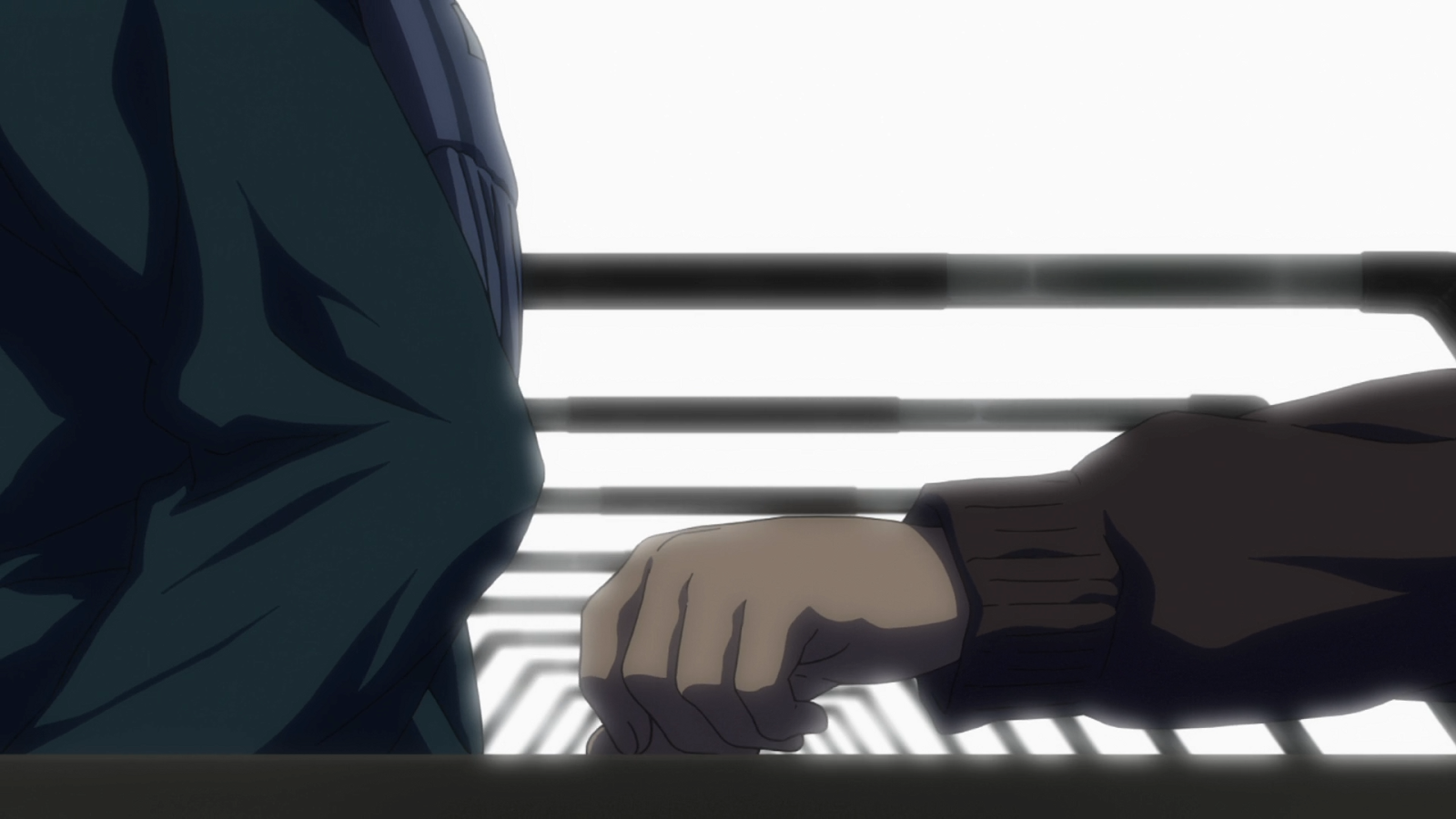
Kyon's final choice, heartbreaking as it is, is also delivered in a neat package, with the scene on the left. It's a reference to the scene before where Nagato succeeded in keeping Kyon in her world (Her house), but this time, Kyon didn't give in.


This one (in the right) actually means 2 things: Nagato accepting the humanity she's gaining, and actually joining the SOS brigade, which she actually never did before.
There's a few examples, but I could delve deeper if needed.

In the scene where Kyon assures Nagato that if she goes missing, they'd go through seven hells to get her back. Here the interesting part is actually just a minor one, but one with great impact to the whole supposed continuity. It's the one on the left where Kyon puts his coat on Nagato. This means so goddamn many things, and it actually changes the dynamics of the series so damn much in a way. Kyon now takes responsibility, and takes his part as John Smith, the active defender of the world whatnot. It's told in the end, but the actual scene where it happens is here. It also serves as an oath to protect Nagato if needed. It's also a form of apology for all the things that happened to Nagato etc etc etc.
There's some symbolism for ya! (God, this blogpost looks like a clusterfuck)
torstai 6. kesäkuuta 2013
The Melancholy of Suzumiya Haruhi, Part 2
Surprisigly Complex: Suzumiya Haruhi, Connections and Endless misery
Last time I concluded in a question: Does Kyon feign ignorance to Haruhi's feelings? It may be or may not be, but I'll try to take that to account.
Bamboo Leaf Rhapsody is the most important episode in the series, and even the series itself recognizes this. So what's all the fuss about the Tanabata 3 years ago exactly? Taking account both god theories, it ís either:
1. Kyon going back in time three years and making Haruhi believe that supernatural exists
2. It's a simple effect of having three versions of a god (Kyon) in the same place.
Nonetheless, I am going to actually go with Haruhi-theory now, to give my own viewpoint: I see it as being possible that the reason of significance is shown, but from another angle. This is my theory, thus it may be confusing or not make any sense.
 |
| Even Kyon is confus of this shit. |
I see it as this: Kyon was originally born 3-5 years prior to Haruhi (Making him a high schooler when Haruhi was in middle school), and in the original universe, on July 7th, stumbled to Haruhi by accident, carrying a beautiful girl that Haruhi did not believe was his sister. Kyon then proceeded to do the markings as is, and when asked his name, wanted to protect his identity (as he remarked: "If this had been the first time encountering such middle school girl, I would've thought of her as genuinely dangerous." Though it's not clear if he's actually referring to Sasaki, it's left open), and called himself John Smith. When later asked about the supernatural, he answered in a manner that he would've wanted (It's referred in the very first episode of the series), practically the same answer he gave in the series. This then activated Haruhi's powers as she probably kinda fell for him, wishing that they went to the same high school, which then changed Kyon's life in a way that he would simultaneously be there on Tanabata and the same high school as her, by time travel. This would make Kyon a slider, and Kyon as a slider is touched again in Disappearance, where instead of actually transferring to another world, the world itself changes. I'll come to that later.
Also, this would in a way explain Kyon's affection to Mikuru, because the only way to get Kyon's absolute trust required to get him to travel in time is to get his affection. And if Haruhi didn't want to meet a real time traveler, but a person who has experienced it, it makes even more sense. To make the connection to Kyon being able to be in the same high school as her while not technically being a time traveler from the future, she used the only thing he had with him as a reason, the girl. Thus was Asahina Mikuru born in the future.
The true meat of Bamboo Leaf Rhapsody is not what happened, but what it caused. It is the very reason the series' plot exists, and it's told so discreetly it's admirable. It got me to really love the series once I realized that.
Okay, onto the thing that almost all people despise in the series... Endless eight. They call it pointless, laziness of the animation department and just a waste of time. I beg to differ.
First things first. Endless eight can be seen as two things also, depending on theory:
1. Haruhi really wants the summer not to ever end because she is having so much fun
2. Kyon wants more time to get his summer homework done
 |
| One of the only things keeping her sane? |
While both are valid in a way, the Kyon-theory falls flat. Kyon knows the pain Nagato is going through, and would still want more time? It seems too selfish to be real. Haruhi is oblivious of Nagato's pain, and thus doesn't give jack. So now to WHY KyoAni made Endless Eight as it is known today.
Endless Eight boils down to being even riskier artistic decision than Bakemonogatari's character lens. It frustrated so many fans so much, that many never watched the series again. It was a gamble of life and death, and simultaneously they succeeded and failed. I'm on the camp on who it succeeded on, as I eventually realized the reasoning behind it, but most people who saw it were just baffled. I personally even think the anime version (Eight episodes) was better than in the novel (One sole chapter).
I was one of the ones who almost quit. But still every week I came back to see if the endless eight had finally ended. And when it did, man was it glorious. But does it still deny the pain I went through waiting for something to change? For the seemingly endless misery of seeing the same things again and again? If I did my "drama" properly you might have already guessed the real reason behind the Endless Eight. It was meant for the ones who were following the series every week. If you watched the second airing of Haruhi after it was finished or after the endless eight, try to put yourself in the shoes of a watcher who watches it, and waits every week for a new episode.
 |
| Sadly most don't even last eight |
For me, the frustration in the moment was enormous. I wanted it to end. Really, to just end. I was actually kind of desperate, because one of my favourite series of all time was airing every week yet it was in a standstill. And that was the point of it. You couldn't escape the fact that it wasn't going to change. Of course, we knew the airing would end at some point, but would the rest of the series be just this? One episode, all over again? We couldn't know. It really was annoying, but only after, when I got a tiny hint, I realized it. The god of the series, KyoAni, was torturing me deliberately, to make me feel what Nagato feels. At that point the character of Nagato changed in my mind (This was still before Disappearance) as I realized Endless Eight's ingenuity. It was made to prepare us for the fact that Nagato was going to change. It was character progression without dialogue, without any action in the whole series (Kyon's random thoughts are not counted as they differ in every loop and he forgets them nonetheless). That was one of the biggest mindfucks I've ever come across. And also one of the reasons I still adore this series.
Of course, if you watched the series afterwards, it wouldn't really make sense, would it? It's an ingenious trick, but after the first time it's useless.
So we were practically made to feel the pain of Nagato in miniature size. Of course, the difference in patience of an Android and a human is incomparable (It's even lampshadowed in Bamboo Leaf Rhapsody, where Kyon said that it would require a world of patience to wait the three years Nagato has been on standby mode), but I think the risk they took was still huge. Expecting people to wait eight weeks? It's lunacy. But as we all know, ingenuity and insanity come hand in hand. Every time a person dropped the series for good during Endless Eight is comparable to Nagato committing suicide.
Think about that.
keskiviikko 5. kesäkuuta 2013
The Melancholy of Suzumiya Haruhi, Part 1
Being a
seasoned Haruhi-veteran (I’ve read all the novels except 11) Watching the anime
shows that the people at KyoAni really knew what they were doing.
In
mindbending anime’s like Haruhi watching the first episode usually activates
the part of my brain that just seeks clues for foreshadowing. Given that there
are multiple theories about this series, I will be going through many of them,
trying to pinpoint differences in execution, giving reasons to some things that
may make more or less sense.
This will
be different from my analysis on Bakemonogatari, where I explicitly went
through one point of view that everyone seemed to miss. These theories of
Haruhi are well known, but I’ll give my own twisted explanations on the
matters. I’ll be telling them in one huge pile of text where I actually give my
take to also some artistic touches that make the series interesting to watch in
hindsight. And spoilerrific, this time I believe it’s going to be worse.
Surprisingly
Complex: Suzumiya Haruhi, The beginning of the awkward, unrequited love
The whole
point in the Miracle Mikuru episode being the first is to give the watcher a
huge batch of foreshadowing to something miles (More exactly one “season”) away.
It’s also there to serve as an introduction to the batshit crazy stuff of
Haruhi…
 |
| Prepare to break the monochrome... 3. 2. 1... |
One of the
most obvious things one notices in the beginning of the series, is the
monochrome which breaks with Haruhi’s introduction. It’s an obvious reference
to the fact that Haruhi brought some simple joy into Kyon’s life that lies
beneath his snarky and facepalm-y surface. It also supports the both general
theories of godhood, Haruhi-theory and Kyon-theory respectively.
It supports
Kyon-theory in the way that is pointed out actually not too long after that,
when Kunikida explains Taniguchi how Kyon has always liked weird girls. So
could Haruhi be just Kyon’s fantasy of meeting a batshit crazy girl with
questionable morals and motives? Could be, or…
It could be
Haruhi’s fantasy of showing the light to at least one person. Finding a one
person to talk with. As such she could’ve created all the crazy stuff we’re to
encounter in the series just to find a supernatural friend / a man to love (I will follow up on this in Part 2). Heartwarming in a
way, but goddamnit. As we later see in the series, Kyon could be just a slider
from a world where they never went to the same high school. When I get the Bamboo Leaf Rhapsody, I’m gonna talk less Tanabata and more theory.
The rest of
the episode is fairly normal “Haruhi being Haruhi” from the hitting the globe
with a ball to grabbing Asahina. Taniguchi’s clearly butthurt attitude toward
Haruhi is still funny to watch though. It gives a nice touch of a world that’s
more alive, as there are things we’re told by simply the actions of the
characters, without obvious remarks of it. It also raises the question: did Asakura become what she was because Kyon wanted to prove Taniguchi wrong, or just because you should beware the nice ones?
The latter episodes
give information about the Tanabata incident 3 years ago, and give the
information that our supernatural trio have been told by their higher ups.
Also, I would want to give a side-theory which doesn’t really have anything to
do with godhood. I would say, that in a way, it’s possible that Nagato, Asahina
and Koizumi are actually the leaders of every given faction. Koizumi is the
easiest to explain, as he has all the spoils that only a very high-ranking
officer would have. Nagato on the other hand is possibly the an incarnation of
the Data Overmind/ Integration Thought Entity, that actually regains
consciousness / evolves during the Endless Eight (Which is actually more
ingenious than many think.). The Adult Asahina being the leader of the Time
Travelers would be no surprise, as she doesn’t really have any of the
restraints the Young Asahina has.
 |
| I highly doubt that. |
The Haruhi
as a god wanting to be sort of comicbookish character makes sense, like how all
those times she says to Kyon how “It’s not a date!” when they draw lots when
they divide on their Mystery Searches. Why did she not end up going with Kyon
at any of those? Because in a true comicbookish sense she wouldn’t. It would
make it mysterious. Yes, she’s weird enough to frustrate herself to make her
character more real.
The other
side of the argument lies in Kyon’s desire to get on a date with Asahina and
Nagato, but while it may seem immediately more obvious, in the long run it
makes no sense. IF not for the fact, that he may actually be searching for the
comicbookish situation, where a pretty girl just randomly tells him that she’s
supernatural. In that sense, yes, it makes sense.
Regarding the two theories of godhood, interestingly, the longer the series grows, the Kyon-theory actually starts to make less sense, until it pops up again (Sasaki, but that can be interpretated...). The fact that all the weird things happen to Kyon actually enforces to think differently of Haruhi as a character, because maybe she doesn’t want to actually want to experience all that weird stuff, but more like wants to meet a person who has. If you think about the character it actually kinda makes sense.
Then comes
the real juice. The dimension created in the last episode of the first season,
where Kyon and Haruhi would’ve been trapped forever if Kyon didn’t act up. If
Kyon really was god, why would he create that dimension? Does he really have
the guts to destroy the whole world because he feels it’s a pain in the ass
(Which is actually denied in Disappearance). He whines without purpose, not
trying to really change anything.
 |
| Yes they do. |
In my mind,
this actually enforces the Haruhi-god theory that the series itself throws on
us. She created that dimension because she felt Kyon wanted there to be a world
with everything cool in it. And she also wanted to be with him. Kyon probably
knows about Haruhi’s affection to him, but either he acts that he doesn’t
because he doesn’t know what to do with it, or because he doesn’t want to deal
with it.
Does Kyon
feign ignorance?
Join me next time for Bamboo Leaf Rhapsody and Endless Eight, where I go truly outlandish and explain my own view of the significance of the Tanabata 3 years ago -incident.
Tilaa:
Blogitekstit (Atom)