perjantai 18. huhtikuuta 2014

Rick and Morty: Welcome to C-137

Was supposed to do Haibane Renmei, but it starts so slow that I need to try watching it again sometime later.

Well, this is the first time an American cartoon is under the magnifying glass, so it's some kind of first.

This series has really risen up from all the series out there, with it's hilarity and ingenious plot twists. This time lots of this text can be found in Reddit, because I've taken part into the conversation there, but there were some people with a keener eye than me, so all credit to RickAndMorty subreddit, here we go!

Also, the title is kind of relevant, but kind of irrelevant

Surprisingly Complex: Rick and Morty

So, what should we start with?

The Evil "Eyepatch" Morty definitely has a connection to Rick C-137 in some way. Here are some of the possibilities:
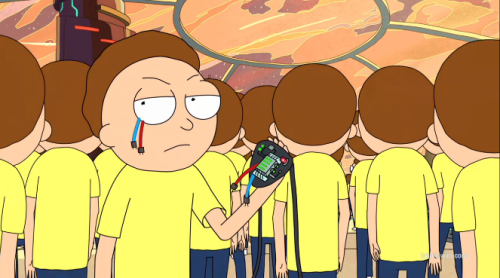
There's definitely something going on

  • "Eyepatch" is Morty C-137.
  • "Eyepatch" is one of the later Mortys that Rick C-137 has had.
  • Rick was in an operation to take down "Eyepatch" some time in the past.

They all have almost zero hard proof, but they are implied, and it can be deducted:


  • Rick makes a statement about cocky Morties, and the next scene is the reveal of the Evil Morty
  • In Rick C-137:s memories we see Morty as a toddler, even though in the dimension that the series started in Rick had been gone for twenty years, longer than that dimension's Morty had been alive
  • The Evil Morty wanted to download specifically C-137:s brain, even though he had already killed numerous Ricks who should have the same intelligence. 

With those points, I would lean onto Morty C-137 or later Morty theories, because they imply a deeper mutual understanding. 

Following with that, I'd like to delve deeper to the C-137 theory (My personal favourite):

  • It would seem Rick C-137 cares for his first Morty more than others (He gets teary-eyed at the toddler Morty). Having the first one be the Evil Morty would make sense because he could be the one who abandons C-137.
  • Right after the toddler Morty, we see a Morty, shocked with a jumper cable. This could be a mark of his current "not giving a shit" attitude coming from losing his first Morty tragically.

Now an expanded theory of the dynamic of Mortyness:
Maybe there is something behind this hatred...
  • Morties have a maximum years of usage.
  • After that time, they start to rebel and become cocky
  • Going with this, we can see our Morty struggling with this in the future.
  • Extra: Council of Ricks aims to liquefy Rogue Morties and it is partially the reason for Rick C-137 not being in the Council
So, how does this make any sense?
  • When giving Rick C-137 the voucher for a free Morty, C-137 cuts the Council Rick short. Knowing how this series is, there could be vital information there.
  • Rick talks about a cocky Morty like he has experience, and deducting the fact that he was in contact with a Morty when he was just a toddler, we can see a possible connection with extended exposure of Rick and Rebelling of Morty.
  • Extra: Rick seems to be in very toxic relationship with the Council. Knowing that all the Council's Ricks ARE Rick, there must be some good reason why he's not in the council. There was probably a big fight regarding something, and this Morty liquefying is just an honest guess. It would also explain Wubbalubbadubdub, as Rick could easily still be depressed over losing his first Morty.


There would definitely be more, but... I don't remember them just now.

TL;DR?
I dunno. A Morty's a Morty.


keskiviikko 16. huhtikuuta 2014

We hit 10k! Also future updates

10k Hits! That's nice... Anyway, there's hopefully something to write about this week... When did Hanamonogatari start again? End of May? Dammit.

Well, a series called Haibane Renmei sparked my interest... We'll see if I'll pull my head out of my ass and actually write and figure something out. We'll see. Haibane Renmei is written by the guy who wrote Lain, so my expectations are high, sadly. Sadly because the expectations I have usually may break the series, because I overanalyze, or should I say PREDICT the outcome too easily. I had REALLY high expectations with Lain, as it's hailed as one of THE series, and now, months later, I see what the buzz is for. My initial text may be a little harsh on it, but the series kind of sinks in and in retrospect is better than I initially took it for.

All of my favourite series I started to watch with either expecting for something else or totally ex tempore, without much thinking. Okay, except Clannad, but I got the tearjerker I asked for.

So let's see if Haibane Renmei will climb the list.

perjantai 4. huhtikuuta 2014

sunnuntai 26. tammikuuta 2014

Taking a break

Well.. I'm taking a break of sorts, because my high school finals are coming. I'll see you after those probably.

lauantai 11. tammikuuta 2014

Attack on Titan: Beyond These Walls

Well, I kind of saw this coming. This is insanely spoiler-filled, and from the manga, so if you want to avoid messing probably the best twist this series can pull, I would highly say, ever, steer clear.

Surprisingly Complex: Attack on Titan / Shingeki no Kyojin

Okay, so for all you in there, and I can expect a LOT of attention for this one, hopefully, I have a confession to make. This series never surprised me, not once. But, it doesn't really matter, because the most fun part was just watch things unfold, as this time it was fun to watch the characters be surprised by some of the kind of obvious twists (Unlike... Something like Lain). Oh, the Titans were human all along? What a fucking surprise. Oh, and they were... Okay, I'll go into that later.

So, as you can tell, this time I'm tackling things that may or may not come in Attack on Titan in the future, of which hints have been thrown around for the whole series. And what do I mean specifically with "Beyond these walls?" This is all just some insane theory, so... Do apply critique.

That's pretty high-tech stuff for year 850
Let's start from the beginning. From the year 0 in fact. We know, that something has happened that has reset the calendar. Why would they otherwise have such sophisticated technology as 3D-Maneuver Gear? Of course it's possible that if history had skipped the "Dark Age", technology of those sorts could make sense. Anyway, this is just a side thing, so...

The Great Lie, Part 1:

We've been lied to. The history that has been told to the characters, and as such, us, has been altered. If the calendar has been reset, it had been done way before Titans came into play, implying that there are things in the past that we are completely oblivious about. This is not much, but it gets better.

The Great Lie, Part 2:

Okay, it has been established that Titans once were humans. It has also been established that humans can be turned into Titans (Connie's hometown), in a short time. We've also seen that Eren's father gave him some serum that made it possible for him to become a Titan shif-. But wait, aren't those two things kind of different? I'd say no. I would suggest that once upon a time, someone invented the Serum A, which turns people into titans, and Grisha (or someone else, more on that later) invented Serum B, which turns people into Titan Shifters.

So where's the catch? It was always about people turning other people into titans and turning them against other people. So, where does this lead?

The Great Lie, Part 3:

The Titan War. Wait, that's not anything the series has ever mentioned?! Exactly. There was most probably a war between two nations, other being some unknown force, and the other being the people who are now within the walls. See where I'm going with this? The Unknown force had invented Serum A, and now that we know that Titans can be controlled, they probably used them as a weapon of mass destruction upon the other country. It also explains why the Titans don't actually eat people. And here comes the fun part. We know that the walls are made of Titans, right? So... What if the walls had another reason to exist. What if... They aren't there not to keep the Titans out, but to keep the people inside?

So, what exactly is beyond Wall Maria?
Where does this lead then? To a measly fact that what if outside these walls, there is a peaceful land without the fear of Titans, without the restriction of the walls? A land which uses Titans as a tool to keep the people inside the wall in check, so they can't come hinder their lives?

The Great Lie, Part 4:

So... What sense does this make? Why would the people of the outside do something so cruel? Because the high-ups inside the walls are stubborn dicks who don't want to cooperate. There may be still a war going on with the other nation, we just don't know of it.

So hey, what about Titan Shifters? What's their deal? Well, in short, Grisha invented Serum B. It's hard to pinpoint why, but it's possible that he escaped, and took documents with him, got captured by the other nation, and was imprisoned, but now the unknown force had the Serum B. It may also be that Grisha was a citizen of the other nation all along, which diverges to 2 paths: 1) After the Attack, he panicked because he knew where the attack came from, and escaped out of fear of being found out. 2) After the attack of Shiganshina, he injected Eren with the serum, and left to kill those sons-of-bitches, and probably put the same serum to his own veins. Of course the last one is the most epic, so... Why not?

The Great Lie, Part 5:

Well, this is just tying some loose ends. So... We've seen Reiner and Bertolt getting their friend eaten by Ymir, who probably had taken something like the experimental Serum B (This supports the theory that Grisha is from somewhere else and didn't invent the serum. Or the Serum B was only completed when they got Grisha) which screwed her up pretty bad, as she couldn't turn back into human. It's possible that because of that, she became a rampant Titan where Reiner and Bertolt lived (Which may actually be outside the walls).

So, what do you think? Too far-fetched?

TL;DR?

Titans are probably a weapon of mass destruction. Also some insane theory of an other nation or something.

E: Shit, plotholes. Gotta... Repair...

E2: Why did I split this into parts, again? I dunno.

maanantai 30. joulukuuta 2013

M.S.S.S Episode 26

Okay, that was a good ending for a series.

Surprisingly Complex: M.S.S.S Episode 26

Well, going with a bang, so to say. It was more CHOCK! (Wood hitting head), but still.

It was never confirmed that Kaiki is dead. Thus he probably isn't. If he is, well shit. He may be lying about his death, or he may have faked his death, we won't know until the next time he appears or doesn't.

We finalize the current series and the current arc, with something to learn from. Think about the word "deceive." How many times was it used in this episode? The answer is a lot. There was the final deceit, which would seem pretty improvised, but I'd say it was Kaiki's contingency plan. It was the ultimate move he could use, the words of reassurance. Words assuring that her own fatalism is not always right, that what she thinks her destiny is and always will be, is just an illusion. Words about the possibility of change, of other lives. He of course later defines the words as the obvious, as the obvious things adults tell to children. He didn't define them as the lies adults tell to children, even though from the way he speaks, he would seem to see those things just as illusions. But he acknowledges that for others it might not be too late, even though the basis of his words is that it is never too late, even if he may believe that it is already too late for him.

Kaiki told us that he hates irreplaceable things, and that he loves money. Of course, it comes from the pain of losing something irreplaceable, probably more than once, that led him to a choice of either clinging to those irreplaceable things and being in pain, or letting them go and never thinking of them again, never putting scarcity value on anything. He made the choice he believed in, the one where everything loses their scarcity value, where individuality becomes almost nonexistent. It became his curse, as he became unable to put value for things outside money, that was the ultimate idea of value without scarcity value.

That's all theory though, as he might just be lying. But there is evidence for it. He has talked about money before, when he talked to Karen. Then he emphasized on the fact that money is practically everything, but I think back then it was more important to make the point for the oh so justice-driven Karen that he didn't say everything. I think that his point there may be a hidden one: Money is everything, money is replaceable, thus everything is replaceable. And to some extent, he's right. But he's also wrong, and that he knows. He knows that the only irreplaceable thing is your own self. If you escape and hide it forever, you will never get what you want.

So... Back to some of the things I said about previous episodes. Nadeko, this time, Nadeko as in Nadeko, not Medusako. Nadeko is one who hid her true self, hid what she wanted, and let on an image of herself that just wasn't true. That made her dream unachievable in the sense that she lied to herself that she didn't even want it. This led to her internal fall, as she denied what she wanted, and replaced those desires with desire to be with Araragi. She wanted to hide her true dream so hard, that she accidentally denied the whole world. So in some sense, we could say that sometimes your dreams outweigh even the whole world. It may not hold water for every single one of us, but for many it does. It is the one singular thing that we want. The one we know may not make us happy, not even the most happy of all the options, but the one we want.

Okay, my text is turning weird, so I think it's time to wrap up this season. Oh wait, It's still not time for that. I will first wait for the Bluray and torrents to come so I can watch it in HD again, and then make a full-sized text (WITH PRETTY PICTURES, SO ALL THE BETTER). Even though this, as the final text of this series' singular episodes is already quite long. The format of the coming text will probably be little different, with me analyzing different theories I have in detail, so it will be a long-ass text. Most probably the longest that I've written so far. But, I haven't even begun my whole Monogatari retrospective yet, so we'll see.

TL;DR?
Err... Nothing is irreplaceable, and Kaiki's obvious is obvious to everyone but him.

maanantai 23. joulukuuta 2013

M.S.S.S Episode 25

WHAT, IN, THE, ACTUAL, FUCK?

Surprisingly Complex: M.S.S.S 25

There was so much stuff here. And the ending is the worst (best) cliffhanger in a long time.

First off, we never got to know what was in the closet, and I think it's a good thing. Of course, there was something there, and you can know what was there (It will be told in the next episode probably), but for now at least, all we know is that it's something that Kaiki looks at with disgust. But even if I never get to know what it is, I'd be content, but would probably get the information just in case.

So... Kaiki vs Hanekawa, the battle of the minds, or more like conversation. Hanekawa also again talks with her cunning undertones (referenced from my last post) and almost gets the information she wants. But, that's just theorem.

The real meat comes from Hanekawa's analysis of Nadeko being so deep in the pool that is her self that she cannot see other people anymore, only reflections of her own self as other people. "No matter what is said, their words will not reach them", you should have heeded those words, Kaiki! It's not that she couldn't be deceived, but that she wouldn't want to believe in the deceit. She would deny the deceit wholeheartedly, and probably go on a rampage. She didn't want to kill Araragi and co., she just concluded that she wanted, in her own insanity. It wasn't about killing them, it was about her own deceit of herself of killing them. Sounds like a tangent, but it was like her love towards Araragi, she clung onto it not because she loved him, but because she concluded that way. Not by introspection, but by pure delusion of a world she thinks she wants.

Chronologically, the next step is Senjougahara admitting that Kaiki never lied to her. Where does such a frivolous idea come from? Ironically, from the truth. It's just the use of right words. It's true that Kaiki never lied to her, but it is true that he deceived her. If for example, she was pleading if Kaiki could help her, he would say yes. BUT, the point is not if he can, but if he will. It's not the things he says, but the things he doesn't say.

Then we enter the world of theorem and hypotheses. It is revealed that Kaiki has done things before to benefit Senjougahara that were of little or no gain to him at all. He wiped out the cult Senjougahara's mother was involved in, he had driven Senjougahara's parents to a point of a divorce because Senjougahara would have no future otherwise. Who is a good guy, who is a bad guy? That question is a ruse. No person is good or evil, people just do things that are perceived either selfish or altruistic, and they do them of their own reasons. Kaiki believes this, and thus justifies everything he does solely on the fact that it is to his interest, no matter the real reason behind it.

The real abstraction comes from the fact that last time he tried to help someone, it was an enormous failure, granting him next to no money, and the subject to be "saved" was too weak to accept the rescue. Maybe it's just some kind of karma, that Kaiki cannot save people. It is not touched here, but I think that all this has something to do with Kanbaru's mother. But it's not brought up because Yotsugi either didn't exist back then or doesn't want to offend Kaiki.

This leads to an interesting part about Kaiki's conscience. Maybe he failed to actually help Senjougahara, even though he tried, and that led to him making a compromise of driving her parents to divorce because it was the only way to let her have a future. Something similar may have happened with Kanbaru's mother. It's a possibility. What if he actually blames himself for a lot of things, he just never shows it? He has motivations beyond money, that much is known. But does it come from actual altruistic intent, or from just paying back something that he regrets? It is surprisingly hard to actually answer that.

So, with all this in mind... When Kaiki goes and executes the plan, he seems to be deliberately helping someone, which has been proven to cause failure in the past. He seems to regret those failures, and that's why he wants to set things straight. Sadly, it seems that the plan has gone awry. Kaiki really isn't very good at helping people...

TL;DR?
Kaiki has more to redeem than meets the eye...